

Which Comes First? The Chicken or the Egg? Planning or Grantseeking?
Planning, Work Mode and How We Move Forward
Are you Grantcentric?
An old term I once used when talking with others about grant seeking and grant writing was “grantcentric”. Are you grantcentric? Meaning are you seeking to fit into the grant requirements when an opportunity is discovered? Are you trying to create something that would work? Or, are you holding your mission focus as the priority, to see what grant opportunities meet what you wish to achieve. While an old term in my mind at this point, the concept is still relevant and can help view how institutions approach opportunity and use relevant grant funds to achieve goals and move forward.
What Comes First, the Focus or the Funds?
A recent blog post by The Grantsmanship Center reminded me of the Grantcentric trap, “Which Comes First, the Program or the Grant?”1 The article asks the question at the beginning, “When a funding opportunity comes across your desk, are you thinking about how well it fits the work you’re already doing, or are you thinking about how to shape your work around it?” Or perhaps propose something brand new, something big because the funding award seems like it could handle the budget required? The article argues that a strong program focus can be demonstrated within a funding request and shows that it was designed prior to a proposal being developed, and that the grant, if received, would be funding something real. The Grantsmanship Center sums up the true role of the grant proposal; it serves as a communication tool. “The grant proposal’s job is to convey the value of something that already exists, to a funder who is looking for exactly that kind of value.”
Is our Grant Planning Reactive or Proactive?
When we think of grant funding, are we taking a reactive or a proactive approach? How does grant funding fit into the institution’s overall plan? Where are the appropriate places for grant funds to be applied and what are the key areas of need? Goal 4 under the Resources pillar of Virginia Western’s last strategic plan point to grants as well as other opportunities: Maximize new and existing funding sources. Could we use this focus to further refine a strategic approach? Absolutely. What might that look like?
Let’s reference the grand ‘ole resource, Grant Writing for Dummies by Beverly A. Browning2 for some of the nitty gritty. Having a true fund development plan for grants can “guide your organization in adopting priority programs and services and identifying potential grantors (or partners) you plan to approach with grant requests.” When we improve our planning with an overall proactive strategy, including designing opportunities and initiatives for new funding partners and developing those relationships, we can do so much more. How about a “If… Then” statement, to sum it up? If the College plans and presents where we are and where we want to go, then we can seek the right resources to support and expand our efforts.
So on with the planning direction. How can you tell if you’re planning in a reactive vs. proactive organization? Check which way the work is taking you.
- Reactive: Are we finding grants and looking to see if we have a project/program that is a match? Or,
- Proactive: Do we have defined priorities that tell us where we need funding the most?
According to Qualityze.com, reactive organizations participate in short-term thinking: “they focus on immediate results, rather than considering the long-term impact of their actions, they have a fire-fighting mentality and lack process improvement.” Proactive organizations tend to “consider the long-term impact of their actions and seek to build sustainable systems and processes, and they have a continuous improvement focus. https://www.qualityze.com/blogs/difference-between-proactive-reactive-organizations
If we wait for a grant opportunity announcement to start planning, we often won’t have the time to draft a quality proposal. More and more often it seems that we are facing a three-to-four-week turnaround between federal grant announcements and their deadlines. The complexity of application requirements, partnership agreements, MOU’s, data requirements etc., that are necessary, will not be crafted into a competitive proposal in a three-to-four-week period of time. Those are the things that need to be in place before the opportunity arises. The complexity of your work, the way your institution is functioning and the data that you are collecting and utilizing can all be explained in the proposal, but not likely successfully proposed and then implemented if the award is received.
To make a movie reference, “if we build it, they will come”, best illustrates how to strategically utilize the grant funding to support our work – and how to get our chickens moving in the right direct.
So, how can an institution switch gears?
The “Reactive” mode keeps us in our Fire Fighting era, requiring immediate response, and can lead to stress and generally short-term solutions. Making time to intentionally step away from the immediate can offer the opportunity to become proactive. The “Proactive” approach allows for strategic planning and resource-seeking to make long-term plans come to life, keeping your sights on where you want to go. Proactive planning can take goals from high level vision to actionable steps that lead the way to achieving a long-term goal or solution. If the top institutional priorities and needs are known, then research for grant opportunities can be guided by the planning and approach.
Tools are also being developed and refined on the federal level to forecast awards in advance of actual grant NOFO’s being released. A searchable database, a decade in the making, which launched in February 2024, is the Federal Program Inventory (Home | Federal Program Inventory), which offers information on federal grant programs. In addition, the Grants.gov website (Home | Grants.gov) can also release forecast notifications for upcoming federal competitions, which can give you months of lead time in understanding that a particular opportunity is forthcoming. Private foundation grant opportunities can be predicted when there are generally established proposal deadlines that help fit into the foundation funding cycle, yet State funds can be unpredictable, both for when applications appear and when funds will be available to the awardee. Corporate funds (or in-kind giving/matching) are generally something which should be discussed in planning and partnership phases, as it is harder to push those commitments through during a proposal writing timeframe. Each of these opportunities can play a role in planning for success, if a strategic approach is applied to seeking grant funding. There will always be opportunities that arise unexpectedly, but taking a Proactive approach builds a better proposal.
Looking ahead!
The beauty of the world of grants is that there are individuals always seeking to improve and learn from one another, to meet the funding and administration challenges that grant opportunities present. The National Grant Management Association (NGMA) has an Annual Grant Training (AGT) conference each year that offers anywhere from the basics to the latest trends and news related to receiving and managing grant awards. Franklin Saunders, our Grants Accounting at VWCC, went with me this year as finance plays a huge role in how we track and implement the funds received.
In my first-year attending AGT, a session offered by Rob Hogan, a consultant with DRS and Integrated Grants Practice Lead, offered the diagram below3 in a session centered on growing and maturing your organizations grant work. I have thought back on this concept many times and have sought to gauge where VWCC fits along the scale. As you can see, references to reactive and proactive approaches appear along the scale as well. This is a great visual to show in a 50,000-foot view how our institution can continue to grow and refine our grant work.
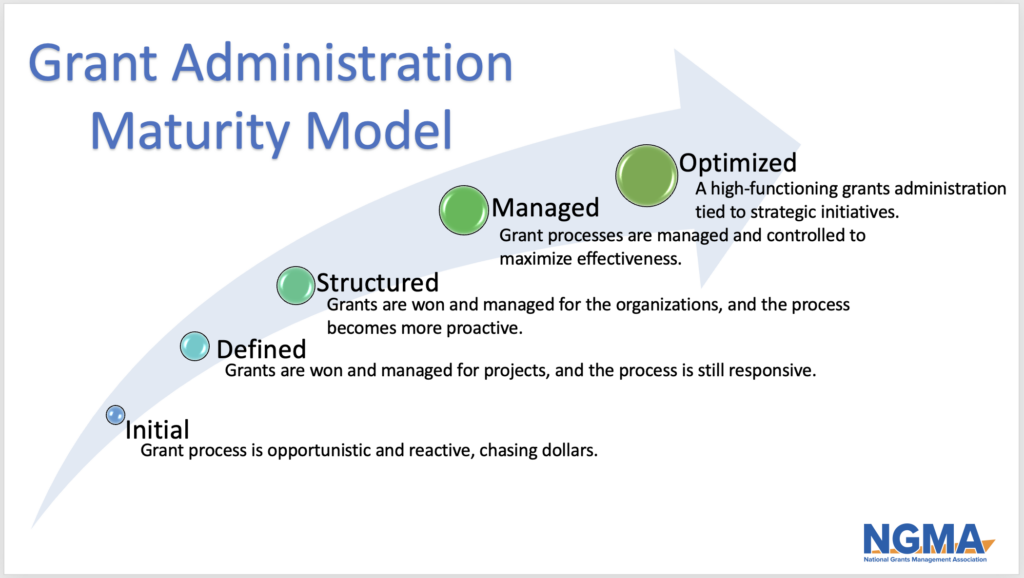
So, now that I have shared some thoughts your way, I am excited for your teamwork in growing our maturity model. Let’s be intentional, using proactive, effective and strategic grant writing and management to optimize our ability to move forward.
Looking forward to exploring opportunities together!
Shelley
Shelley Lyons
Administrative Officer for Grants Administration
Fishburn Hall, F204
540-857-6084
slyons@virigniawestern.edu
- Which Comes First, the Program or the Grant? Why Program Design Drives Funding Success | The Grantsmanship Center ↩︎
- Browning, B. A. (2022). Grant writing for dummies. John Wiley & Sons, Incorporated. ↩︎
- Mr. Rob Hogan, Integrated Grants Practice Lead, Integrated Grants Solutions – DRS ↩︎


 Shelley Lyons is glad to be back on campus as she is a Virginia Western alum, and has served as the Administrative Officer for Grants Administration at Virginia Western since early 2022. Prior to VWCC, her career focus was within the Human Services and Arts fields. She wrote her first grant in 1996 on a whim and has continued to plan and learn since that time. She most enjoys seeing a well-planned project come to fruition, where funder, project manager and beneficiaries can all feel success and see impact.