
By Allison Taylor
Onaca Umak had originally planned to study nursing at Virginia Western, but after applying to the program, she learned she was missing a prerequisite course. That was far from the end of her healthcare education at the College, however. Guided by her academic advisor and inspired by the TV show, “Grey’s Anatomy,” Umak set out on a new path: Surgical Technology.
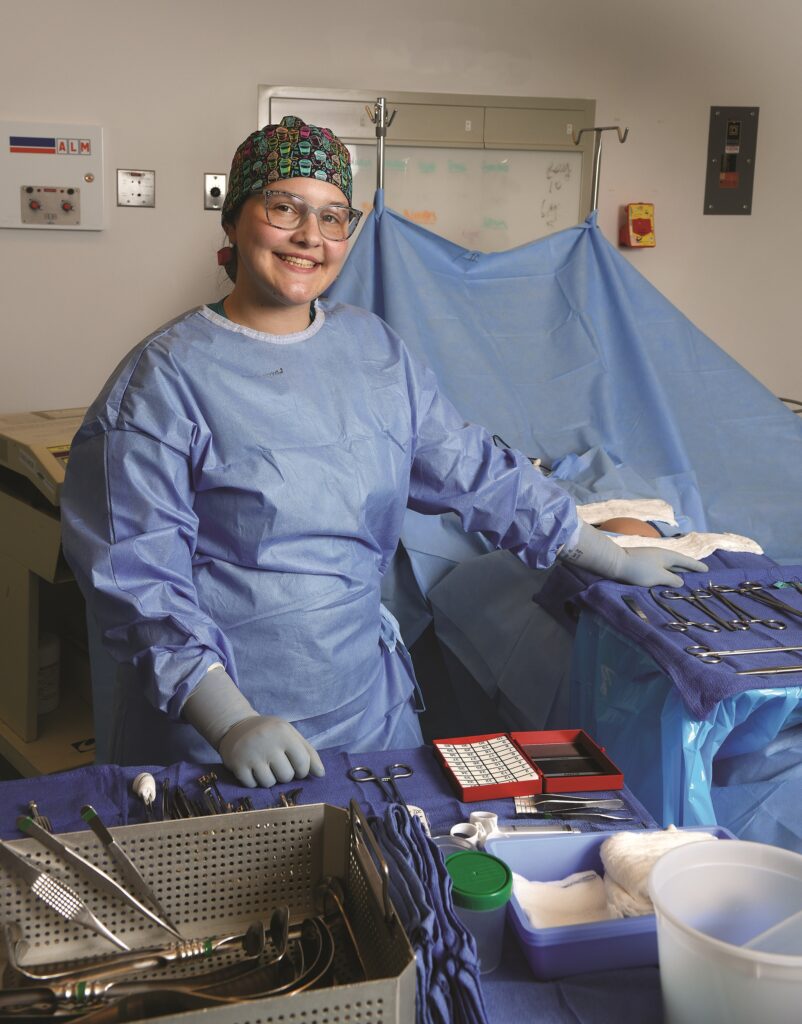
Umak had always been interested in the healthcare field and, as she progressed further into the Surgical Technology Program, she discovered it was ultimately a better fit. Her interests aligned more closely with hands-on medical work, rather than documentation and charting.
“One reason why I really wanted to go into the medical field is because I loved anatomy. I genuinely loved figuring out how everything works together to help us function,” Umak said. “I applied, got accepted, and here we are. The rest is history.”
After graduating in May 2025, Umak accepted a position at LewisGale Medical Center and looked forward to working with the program’s students during their clinical rotations in fall 2025.
“It’s definitely my passion. I wanted to make a difference in someone’s life, and I genuinely feel like I am,” Umak said. “Getting to watch as a cancer is removed or as a burn patient gets a skin graft– you don’t realize how much it affects you until after the fact, and you’re like, ‘Oh my gosh, I really just did that.’ “
Her success story exemplifies how the program’s hands-on training and real-world clinical experience is preparing students to meet a growing need for Surgical Technologists, one of healthcare’s most critical roles. Through the Surgical Technology program — the only one of its kind within 100 miles — students earn an Associate of Applied Science degree while gaining experience in diverse surgical settings, preparing them to directly enter the workforce.
The program was originally offered through Jefferson College of Health Sciences, then Rad-ford University Carilion, before finding a home at Virginia Western, where it is now fully housed and operated after officially transitioning in 2022. The spring 2025 graduating class was the second cohort composed fully of Virginia Western students, marking a significant milestone for the program.
Over five semesters, students learn through a mixture of skills labs, lecture courses and clinical rotations. The curriculum combines professional, cognitive and technical competencies, and meets national quality standards for Commission on Accreditation of Allied Health Education Programs accreditation.
According to the Association of Surgical Technologists, typical duties of a certified Surgical Technologist include: preparing the operating room, including the sterile field; setting up surgical equipment, supplies and solutions; passing instruments, fluids and supplies to the surgeon during surgery; and counting supplies to prevent foreign retained objects. They also advocate for vulnerable patients undergoing surgery.
“The patient’s asleep. They have no idea what’s going on, and if you see a contamination, that contamination could very much be the difference between life and death,” said Program Director Morgan Boyd. “We really work with our students to help them realize it’s not just a procedure — it’s a human.”
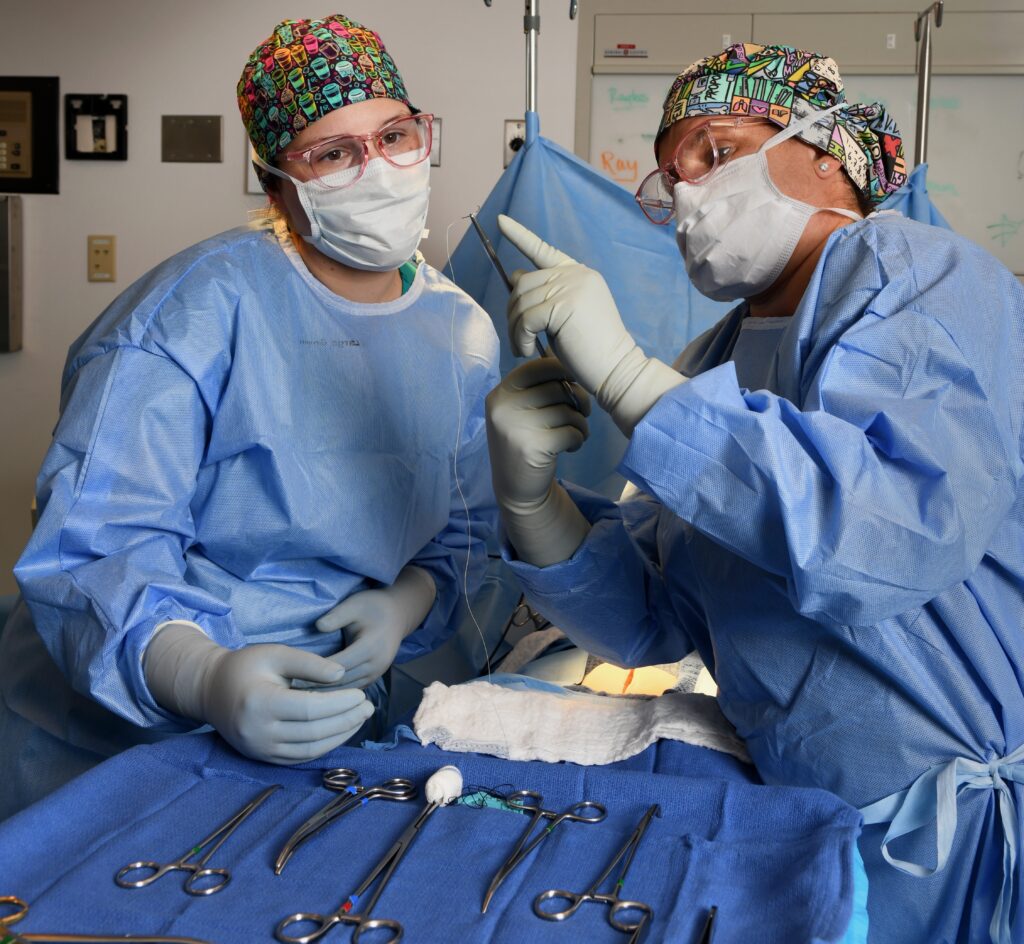
Students are required to do three semesters of clinical rotations and complete at least 120 surgical cases before graduation. However, the program’s students are exceeding that requirement by 1½ to two times.
Students rotate to various clinical sites, which include local hospitals and surgery centers, every four to five weeks. Students work closely with a preceptor, typically a Certified Surgical Technologist, who provides immediate and direct oversight. The program utilizes a clinical tracking system that gives real-time feedback, and instructors observe and assess students’ performance during rotations.
“What’s really cool and full-circle for us is that most of the preceptors we’re seeing in these facilities are our graduates, who know what our standards are, what our expectations are,” Boyd said. “For the program to be able to continue to put out competent graduates that can then shape our current clinical students — that is, in my opinion, true mentorship.”
Outside of clinical rotations, students receive hands-on training in a lab space that has been created from a previously used operating room located on the sixth floor of Carilion Roanoke Community Hospital. The lab provides a realistic setting and includes two mock operating rooms with an operating room table, patient beds, manikins, a deconditioned anesthesia machine, positioning devices and access to general and specialty surgical instruments.
Carilion often donates decommissioned operating room equipment, which makes the learning experience more realistic and helps students familiarize themselves with equipment. In the lab, resourceful instructors find creative ways to help students develop their skills in a controlled environment that simulates real-life surgical situations they may encounter on the job. Exercises such as practicing cauterization on rump roast and using surgical instruments on replicas of human anatomical parts made of Play-Doh or other food items, not to mention the generous use of theatrical prop blood, make for memorable hands-on learning experiences.
After completing their courses and clinical rotation requirements, students must pass the national Certified Surgical Technologist examination, administered by the National Board of Surgical Technology and Surgical Assisting. Upon passing the exam, students are certified to work anywhere in the United States.
Because the program produces well-rounded graduates with experience in all types of surgical settings, most have employment lined up by the time they graduate. On average, recent Surgical Technologist graduates in the Roanoke region start out earning upwards of $23 an hour. Many facilities also offer sign-on bonuses, and upon finishing orientation, new Surgical Technologists are typically required to take “on call” hours, which also add to their income.
Throughout the rigorous program, instructors make a proactive effort to touch base with students frequently and try to be as active as possible in helping students overcome both academic and personal barriers to success.
“It’s an excellent program because we have a 100 percent employment rate and a 100 percent national board pass rate, so the students are getting what they need,” said Marty Sullivan, Academic Dean of Health Professions. “The faculty are exceptional teachers.”
When Umak addressed her fellow graduates at Virginia Western’s May 2025 commencement, she spoke from hard-won experience about pursuing education while juggling work and responsibilities.
A proud first-generation college student who completed her degree while working to support herself, Umak earned the highest GPA in her class and became a member of the country’s most prestigious academic honor society, the Phi Beta Kappa Society. In her speech, she expressed gratitude to both on-campus resources, including the Virginia Western Food Co-Op, Brown Library and Student Life Center, and financial aid resources such as the Community College Access Program (CCAP) and Fralin Futures scholarships for helping her achieve her goals.
“Thanks to CCAP and Fralin Futures, I graduated debt-free. It was all grants or scholarships, and I am beyond grateful, because I wouldn’t have been able to go to college without them,” Umak said. “I worked very hard for everything I’ve got, and I appreciate all the help I’ve gotten along the way as well.”
For more information about the Surgical Technology program, visit virginiawestern.edu/academics/health-professions/surgical-technology/ or call (540) 857-6644.
(This story was published in the Winter 2026 edition of Impact magazine, a publication of the Virginia Western Community College Educational Foundation.)


